









Welcome to the 2020 WHERE Challenge Sponsored by Teck. The Challenge is a national contest endorsed by the Canadian Earth sciences community that asks students aged 9 - 14 years to discover the answers to these questions: What on Earth is in your stuff and WHERE on Earth does it come from? WHERE stands for the places where Earth scientists work: Water, Hazards, Energy, Resources, and Environment. There are thousands of dollars in prizes to be won and you can enter as a group, an individual or a school. All you have to do is use your imagination and dig up some interesting facts about your stuff. The 2020 WHERE Challenge runs from September 14, 2020 to April 1, 2021.
Early Bird Bonus and Teacher Incentive Draw deadline is 11:59 pm, EST December 31, 2020.
Pick a favourite object in your home, school or playground, identify one or more non-renewable Earth resources* needed to make that object and tell us WHERE on Earth those resources come from. You may be surprised by how many are found in Canada. Your story can be told through an essay, a poem, a song or a play, a painting or a poster, an audio, video or multimedia presentation or anything else you can dream up. The more original, the better.
All winners will be announced the week of June 7, 2021. Winning entries may be used as promotional tools to demonstrate how non-renewable Earth resources are essential to our everyday lives.
*Non-renewable Earth resources are substances which occur naturally within the Earth and must be mined, quarried or pumped out from underground. These resources are found in limited quantities and are consumed more quickly than natural processes can replace them.
Some examples of non-renewable Earth resources include:
Many non-renewable Earth resources are recyclable (e.g. glass and aluminum pop cans) but only a small proportion of what is produced is recycled.
The following are NOT considered non-renewable Earth resources:
Need some inspiration? Here are a couple of links to help you get started:
Snowmobile Poster
Look at a snowmobile. Do you see a sleek, powerful machine or a pile of Earth resources? It's both! Snowmobiles are made from many resources extracted from the Earth. View poster >
Cutting Edge Poster
Ice, training, muscle, passion, determination...skaters need them all to get to the top of their sport. But there's more. The equipment, the venues... Earth resources make it happen. View poster >
Power to the People Poster
Canadians use a great deal of energy equivalent to nearly 7,500 kg of oil per person annually. We also produce a great deal of energy, adding alternative energy sources and new power storage methods more and more to the mix. Whatever energy sources we use, the metals and minerals of the Earth, along with the people who find and process them, make them possible. View poster >
Medicine: From the Ground Up Poster
The Earth supplies us with the metals and minerals that contain the necessary components for dietary essentials, care regimes, surgical instruments, medical devices, diagnostic aids and life-saving treatments.
View poster >
Remember, all you have to do is tell a story about any object in your home or school. Tell us about one or more non-renewable Earth resources needed to make that object and WHERE on Earth those resources come from. Your entry can be anything that tells a story: a poster, a dance, a song, a play, a video, a multi-media presentation or anything else you can think of. So dream big, and have fun!
Get ready to turn your imagination loose and develop a creative message to answer the WHERE Challenge: What on Earth is in your stuff and WHERE on Earth does it come from? You may submit an individual entry or enter with a group, youth organization (scouts, guides, 4H, etc) or classroom.
Here's how to get started:
1. Select an everyday object at home or school;
2. Identify one or more non-renewable Earth resources* needed to make that object (such as copper, iron, or silicon);
3. Tell us WHERE on Earth those non-renewable resources were discovered and produced. Were any of them discovered here in Canada?
Now you're ready to create a story to explain why non-renewable Earth resources are so important in our daily lives. Your story can be told through an essay, a poem, a song or a play, a painting or a poster, an audio, video or multimedia presentation or anything else you can dream up! Remember, your entry may be used as a promotional tool to demonstrate how non-renewable Earth resources are essential to our everyday lives.
*Non-renewable resources are substances which occur naturally within the Earth and must be mined, quarried or pumped out from underground. These resources are found in limited quantities and are consumed more quickly than natural processes can replace them.
Some examples of non-renewable Earth resources include:
Many non-renewable Earth resources are recyclable (e.g. glass and aluminum pop cans) but only a small proportion of what is produced is recycled.
The following are NOT considered non-renewable Earth resources:
4. Entry guidelines are as follows:
All essays, stories, lyrics or poems must be less than 800 words. If using a sharing platform for your document, please make sure your file is available for PUBLIC viewing, not private only.
A painting or poster must be 11" x 17" or smaller and submitted at a resolution not less than 150 dpi.
A multimedia presentation must be two minutes or less.*
Note: Submissions over 2 minutes will be disqualified. A script, storyboard or lyrics must accompany the submission. Please make sure your video is available for PUBLIC viewing, not private only.
To submit a video to the WHERE Challenge, simply access YouTube, find the WHERE Challenge Commercial and 'post a video response'. You will be prompted to either create a YouTube account or login if you already have one and upload your video. Finally, head over to the Entry Form and make sure you post the link to your YouTube video when you fill out a form.
Please note that all entries MUST be submitted in digital format.
Electronic Submission
Fill out the entry form and upload your files accordingly (if multiple files, please upload a .zip file). Electronic submission is the best method if your entry is an essay (story or research paper), an audio presentation (song or music) or imagery (painting, poster, illustration, digital painting).
Submitting Video
If your entry is a video, upload your video to YouTube as a 'video response' to the WHERE Challenge commercial and include the link on your entry form.
Snail Mail
If you'd prefer to mail in your entry, please note that you MUST submit your entry in the form of a USB. You may send your entry to:
WHERE Challenge Sponsored by Teck Resources Limited
Mining Matters
1102-150 Ferrand Drive, Toronto, ON M3C 3E5
Telephone: 1-416-863-6463
Fax: 1-416-863-9900
Email: wherechallenge@miningmatters.ca
Website: MiningMatters.ca
Follow us on Twitter: @WHEREchallenge
Don’t forget, you can submit your entry until 11:59 p.m. (EST) March 4, 2021. Also, remember to fill out all categories on the entry form before you submit your entry. All entries will become the property of Mining Matters and Teck Resources Limited, which retain the right to reprint, publish or display the entries in any format.
Please note that none of the entries will be returned.
All entries will be judged based on elements of design, accuracy of information and how thoroughly they address that WHERE Challenge questions: What on Earth is in your stuff? and WHERE on Earth does it come from?
There are three different judging rubrics developed for teachers and students. Each rubric is designed to reflect key elements of the method used to tell the story:
Methods of delivery of message defined:
The following are the rules and conditions applicable to the WHERE Challenge Sponsored by
Teck Resources Limited (the "Contest Rules").
Entry Form: Individual
Entry Form: Group (non school)
Entry Form: School (individual or group)
Thank you. Your WHERE Challenge entry has been successfully submitted.
To follow the judging process and winner announcements, please click here to join our Facebook group.
Your completion of the attached survey would be very much appreciated. Thank you again for taking part in the WHERE Challenge and good luck!
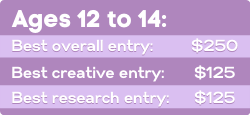
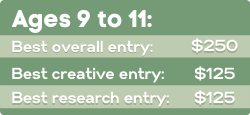
Up to six cash prizes in each of the three categories will be awarded directly to the winning students or student groups. (Up to three prizes will be awarded in the 9 to 11 age group and up to three will be awarded in the 12 to 14 age group for each of the three categories.)
LITERARY PRIZES
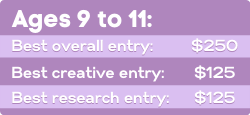
GRAPHIC ART PRIZES
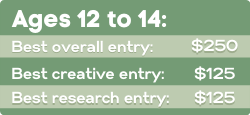
MULTIMEDIA PRIZES
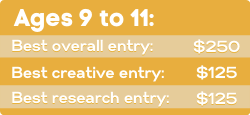
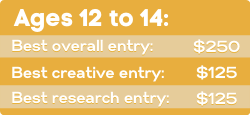
School Prizes (Schools)
There will be three school prizes, awarded to the school, of $500 each. School prizes are based on a combination of quality and quantity of entries from each school.
(School entries are group entries from a school or classroom with an associated teacher.)
Early Bird Bonus Draw
One winner of the Early Bird Bonus Prize of $125 will be randomly selected from entries received before 11:59 p.m. EST December 31, 2020.
Teacher Incentive Prize Draw
Teachers who submit a minimum of ten entries from the same class before 11:59 p.m. EST December 31, 2020 will be eligible to enter a random draw to win a new tablet.
Winning entrants and associated entries will be announced on the WHERE Challenge website the week June 7, 2021.
The following three judging rubrics outline the criteria that will be used to assess your entry and how it will be scored. An equal emphasis is placed on research (40%) and innovation (40%), and a lesser emphasis is placed on mechanics (20%). Twelve points is the highest score you can get in any one category; research, innovation and mechanics.
Snowmobile Poster
Look at a snowmobile. Do you see a sleek, powerful machine or a pile of Earth resources? It's both! Snowmobiles are made from many resources extracted from the Earth. View poster >
Cutting Edge Poster
Ice, training, muscle, passion, determination...skaters need them all to get to the top of their sport. But there's more. The equipment, the venues... Earth resources make it happen. View poster >
Power to the People Poster
Canadians use a great deal of energy equivalent to nearly 7,500 kg of oil per person annually. We also produce a great deal of energy, adding alternative energy sources and new power storage methods more and more to the mix. Whatever energy sources we use, the metals and minerals of the Earth, along with the people who find and process them, make them possible. View poster >
Medicine: From the Ground Up Poster
The Earth supplies us with the metals and minerals that contain the necessary components for dietary essentials, care regimes, surgical instruments, medical devices, diagnostic aids and life-saving treatments.
View poster >
Remember, all you have to do is tell a story about any object in your home or school. Tell us about one or more non-renewable Earth resources needed to make that object and WHERE on Earth those resources come from. Your entry can be anything that tells a story: a poster, a dance, a song, a play, a video, a multi-media presentation or anything else you can think of. So dream big, and have fun!
Popular Geoscience is a series of downloadable fact sheets dealing with Minerals and Rocks and Energy developed by the Geological Survey of Canada (Calgary office).
"I encourage other teachers to participate in the Where Challenge. It is such a great learning opportunity for all involved with the schools -- that is students, teachers and parents as well. We all got more aware of what is around us, where it came from and what it is made of. Many of us had no idea of the processes involved in making things we use every day, from ore to metal to specific objects. We not only learned about non-renewable resources, but we also touched on international trade, careers in geoscience, prospecting and the mining industry and fabrication. We also talked about the environment and the three Rs.
"I believe my students' ideas about the world we live in changed as a result of participating in this contest. Even if we hadn't won a prize, we still would have won, coming out of the adventure with a better understanding of the world, the marvels of industry and the challenges up ahead.
"It was also a lot of fun to create the video all together, to show it to people and to explain what we learned. I know my students will want to take part in this contest again, whether as a group or individually. We all agree, it was a great and rewarding opportunity!"
Suzanne Wernli-Roy, John Field Elementary School, Hazelton, B.C.
"I had my science students participate in the WHERE Challenge and was really impressed with the professionalism of the contest and with the quality of work my students produced. I found it to be a unique and exciting opportunity that allowed students to really contemplate how Earth's resources are used and how we often take the process for granted. Students were excited that there were a multitude of presentation formats permitted (Story, Poster, Movie, etc...) and that there were cash prizes available."
"The quality of work produced by my students was exemplary and I plan on doing the WHERE Challenge again next year."
Kurt Smith, Vincent Massey Junior High School, Calgary Alberta
"It was relatively easy to integrate the WHERE Challenge into the curriculum at the grade 7 level. The kids were highly motivated largely because they got to choose what they wanted to investigate and how they would present what they had learned. You know a project is a success if at the grade 7 level students are willing to do work on it at home and really want to, rather than it being assigned as homework. I think the project met its goals in that the students learned about non-renewable resources and where they are found in the world as well as they have a better appreciation for career paths in geology, environmental science etc. We would definitely consider entering next year. I would suggest that individual prize money is less of an interest or motivator than getting prize money for the whole school."
Crystal Pearl-Hodgins, École Whitehorse Elementary, Whitehorse, Yukon
"Our students benefited greatly from the WHERE Challenge. The idea of integrating their learning into a video with an external competition increased the students' motivation. The use of technology as a medium to demonstrate learning and allowing for creativity really tapped into something special for my students. Now that we have had a great experience participating in the WHERE Challenge I will be able to incorporate this competition into my entire class as it ties in nicely with the grade 7 science unit, 'The Earth's Crust'. This year I used the WHERE Challenge as an enrichment opportunity for my gifted students, but would include more next year."
Amanda Tetrault, River Heights Middle School, Winnipeg, Manitoba
"I decided to incorporate the WHERE Challenge into my grade 8 science class. It was something that I wanted the whole class to participate in and so suggested making a magazine. The students thought that would be fun and following a discussion of all the objects we use in our lives, we broke the items into categories and each class chose a different category. I had one class study food (and its packaging), another did toys and the other did sporting equipment. Students then picked items from within these broad categories and were grouped together based on interest. Therefore in each class we had between 10 and 13 groups investigating different products. When the research portion was complete, students were given different tasks in their Language Arts class in order to produce the magazine.
"I think there were many amazing facets to this project that I have not experienced with other projects I have done with students. First, in the research process, students were looking for information that was, in some cases, very hard to find. They would come and ask me and I would honestly tell them that I had no idea what a product was made from. This made students discover different ways of researching and solving their problems. Often teachers know the answers to questions, or students assume that the teacher knows the answer but that the teacher is just withholding information. In this case, they knew that they were the only people in the room who knew certain facts and they were very proud of this. Additionally, many students ended up phoning manufacturers to get help and came across difficulty in communicating and getting information. They quickly learned the meaning of 'proprietary information'! Students discovered that they needed to formulate good questions that were specific and clear so that people would help them and give them information. In some classes students discovered that certain individuals in the class were very good at talking to people on the phone and getting the information they wanted. In this unique process, students learned about what their products are made of, where they come from and how the earth is integral to our lives.
"The project was a huge success; students were consistently engaged, they were proud of being able to find information online, they felt very mature talking to individuals on the phone and they worked past many different kinds of frustration. In the end, each class worked in small groups gathering information and as a whole class to produce the magazine. This incorporated the understanding of our world, science and LA in a cross-curricular framework in which every student was a contributor. I will definitely have my classes work on this project again next year."
Alison Stuart, Vincent Massey Junior High School, Calgary, Alberta
"As an educator, I thought the 'WHERE Challenge' fit nicely with our school's Inquiry focus on 'Connecting with Expertise' and 'Critical Thinking' Asking students to complete work that professionals tackle in the work world, makes this project authentic and engaging. To complete their research, students needed to go beyond the internet and textbooks, and connect with the manufacturers of their project topics. Students and teachers are always looking for relevant connections to the 'real world' for the work they complete in the classroom and this project met those needs. Other skills students needed for this project included problem solving, time management, creativity, editing, and perseverance."
Jeff Krar and Amy Park (Grade 8 Teachers at the Calgary Science School)
"My students thoroughly enjoyed the challenge of researching different countries and the sources that come from the Earth. They were allowed to let their creative juices flow by making a rap or a video. They love using technology (multimedia resources) to enhance their projects either through a power point or editing their video. Our program (ScienceTrek) usually does a science fair project however the WHERE Challenge allows them to do a science project using different media that they are engaged in and take ownership in. We will definitely do this project again next year."
Susana Chan, ScienceTrek Program, Montgomery School, Saskatoon, Saskatchewan
WHERE Challenge Sponsored by Teck Resources Limited
Mining Matters
1102-150 Ferrand Drive, Toronto, ON M3C 3E5
Telephone: 416-863-6463
Fax: 416-863-9900
Email: wherechallenge@miningmatters.ca
Website: MiningMatters.ca
Follow us on Twitter: WHEREchallenge